
Choosing the right LPG detector is a safety decision, not a simple online purchase. LPG can collect near floors, behind appliances, or inside poorly ventilated corners. A reliable device should respond early, remain stable, and suit the room where it operates. The best Gas Detector Lpg is not always the most expensive model. Its value depends on sensor quality, alarm clarity, installation needs, and maintenance support.
This guide introduces seven practical tips for comparing detectors with greater confidence. It considers sensor technology, detection range, response time, power options, alarm volume, display readability, and certification. A kitchen may need a compact wall unit with a loud alarm. A workshop may require stronger protection against dust, moisture, or temperature changes. Check the manufacturer’s technical data, test instructions, and replacement-sensor policy before trusting marketing claims.
Real-world use matters. A detector that is difficult to test may be ignored until its battery becomes weak. Small details count. Can an older person hear the alarm? Can you read the status light at night? Does the device continue monitoring during a power cut? No detector is perfect. Sensors can age, false alarms can occur, and installation errors can reduce protection. Reviewing these limitations honestly helps you choose a dependable product and maintain it properly. Follow local safety guidance and use qualified installers when required.
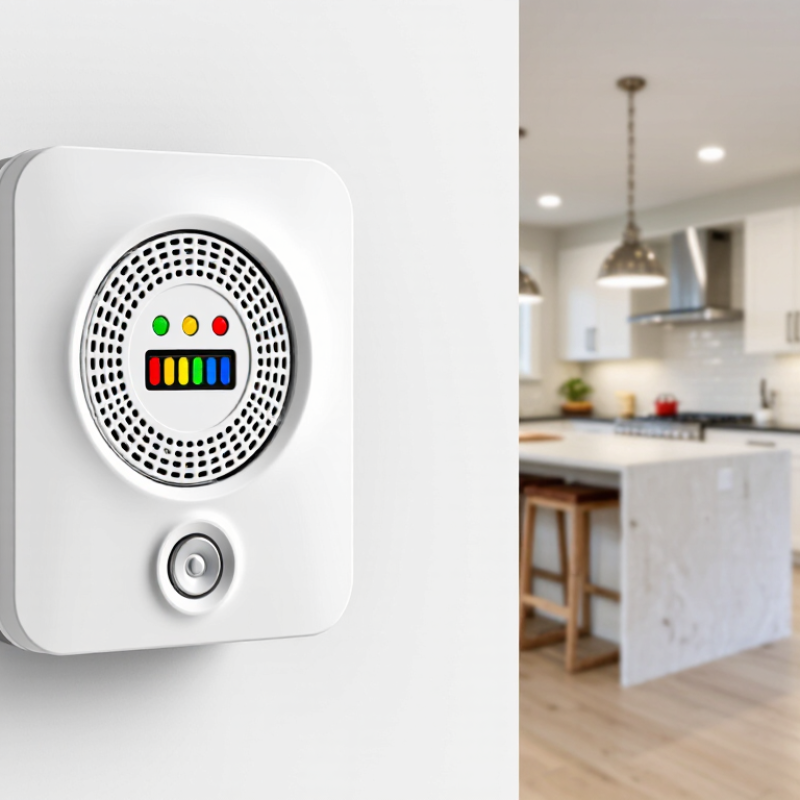
7 Tips for Choosing the Best LPG Gas Detector
Define LPG Hazards: Propane’s LEL Is About 2.1% by Volume
Propane becomes flammable at approximately 2.1% concentration in air. This figure is its lower explosive limit, or LEL, according to the NIOSH Pocket Guide to Chemical Hazards. Its upper explosive limit is about 9.5%. A detector should therefore identify rising gas levels well before the atmosphere reaches 2.1%.
Small numbers matter.
Propane vapor is heavier than air, with a relative vapor density near 1.5, as reported by NIOSH. Leaks can collect near floors, drains, pits, and poorly ventilated corners. During site inspections, placing sensors only at breathing height can miss this pattern. Low-level monitoring is often more practical for LPG storage rooms and equipment areas. However, airflow, temperature, and room design can change the best mounting point.
Choose adjustable alarm thresholds, clear displays, and reliable calibration records. NFPA 58, the Liquefied Petroleum Gas Code, supports ventilation and gas detection planning based on specific hazards and locations. Many systems use an early warning near 10% LEL, but settings must match the risk assessment and local requirements. Do not treat one alarm percentage as universal. A detector is not a substitute for leak testing, ventilation, or maintenance. That assumption is easy to make—and unsafe. Certified performance, documented bump tests, and sensors suitable for propane service provide stronger evidence than a low purchase price.
7 Tips for Choosing the Best LPG Gas Detector
LPG needs careful detection because propane and butane are heavier than air. They can settle near floors, drains, and low equipment spaces. The NIOSH Pocket Guide reports a lower explosive limit of 2.1% for propane and 1.8% for butane. Tip 1: Confirm the actual LPG mixture. Tip 2: Place sensors where gas may collect, not only at breathing height. Tip 3: Check that the detector is calibrated for LPG, not only methane.
Catalytic bead sensors detect combustion on a heated element. They are widely used and usually provide a practical, cost-conscious option. However, they need enough oxygen and may lose sensitivity after exposure to silicone compounds, sulfur compounds, or other contaminants. Infrared sensors measure gas absorption without consuming the gas. They can perform better in oxygen-deficient areas and usually resist catalytic poisoning. Tip 4: Choose catalytic technology for clean, oxygen-rich spaces. Tip 5: Consider infrared detection near process equipment or contamination sources. Tip 6: Verify cross-sensitivity data before approval.
IEC 60079-29-1 emphasizes performance, calibration, alarm response, and environmental suitability for flammable-gas detectors. That matters more than sensor type alone. Tip 7: Review response time, temperature range, ingress protection, calibration intervals, and alarm settings against the site risk assessment. A useful field check includes a real LPG test gas and a low-level airflow test. Perfect placement on paper can still miss gas behind a curb or beneath a valve. I would also question “maintenance-free” claims. Every detector needs inspection, records, and honest replacement criteria.
| Selection Tip | What to Check | Catalytic Bead Detection | Infrared Detection | Practical Choice for LPG Applications |
|---|---|---|---|---|
| 1. Confirm the target gas | LPG commonly contains propane, butane, or a mixture of both. The detector should be configured and calibrated for the intended gas. | Oxidizes combustible gas on a heated catalyst and measures the resulting change in temperature or resistance. | Measures infrared absorption caused by hydrocarbon gas molecules. | Use a propane- or butane-calibrated instrument when the LPG composition is known. If the composition varies, follow the measurement conversion stated by the manufacturer. |
| 2. Verify the alarm range | Propane has an approximate lower explosive limit (LEL) of 2.1% by volume in air, while n-butane is approximately 1.8% by volume. | Common portable and fixed instruments display combustible gas concentration as %LEL, often with alarm points such as 10% and 20% LEL. | Also commonly displays %LEL and can provide continuous readings without consuming the gas sample. | Choose adjustable low and high alarms suitable for the site risk assessment. Do not treat an alarm setting as a substitute for ventilation or emergency procedures. |
| 3. Check oxygen dependence | Consider whether the detector may be used in inerted, oxygen-deficient, or enclosed areas. | Requires sufficient oxygen for catalytic oxidation. Readings may be inaccurate or unavailable in oxygen-deficient atmospheres. | Does not require oxygen for optical measurement and is generally better suited to inert or oxygen-deficient environments. | Prefer infrared technology for inerting operations, enclosed process equipment, or locations where oxygen concentration may fall below normal atmospheric levels. |
| 4. Assess contamination risks | Review exposure to silicone compounds, sulfur compounds, lead compounds, halogenated compounds, oils, and heavy vapors. | Catalyst poisoning or inhibition can reduce sensitivity and may cause a dangerous under-reading. | Generally resistant to catalytic poisoning, but the optical path can be affected by dust, condensation, oil mist, or dirt. | Choose infrared detection in areas with known catalyst poisons. For either technology, specify inspection and cleaning requirements. |
| 5. Compare maintenance needs | Consider calibration frequency, sensor replacement, bump testing, cleaning, and access to spare parts. | Typically needs regular bump testing and calibration. The sensing element may age or lose performance after contamination or prolonged exposure. | Usually avoids routine catalyst replacement, but requires optical-window inspection, functional testing, and calibration according to the service schedule. | For low-maintenance fixed installations, infrared can reduce sensor-related maintenance. Catalytic bead may be practical where routine servicing is already established. |
| 6. Match response and operating conditions | Check response time, temperature range, humidity, pressure, vibration, enclosure rating, and hazardous-area approval. | Can provide a fast response and is widely used in portable and fixed combustible-gas instruments. Performance depends on airflow and sensor condition. | Can provide a fast response and stable operation, but heavy condensation or contamination on the optical window may delay or reduce detection. | Compare certified response-time data under the actual installation conditions rather than relying only on the sensor type. |
| 7. Select the correct installation location | LPG vapor is heavier than air under normal conditions and can collect in low points, pits, drains, and poorly ventilated spaces. | Suitable for point detection when installed where a leak is likely to accumulate and where oxygen is adequate. | Suitable for point or open-path configurations, depending on the application and certified product design. | Place point detectors near credible leak sources and potential accumulation areas. Follow the site hazardous-area classification, ventilation study, and applicable local codes. |
| Overall suitability | Use the site environment, maintenance capability, and required reliability as the final decision criteria. | Cost-effective for many standard LPG monitoring duties, provided oxygen is present and catalyst-poisoning risks are controlled. | Strong choice for long-term monitoring, oxygen-deficient areas, or applications where catalytic poisoning is a significant concern. | Neither technology is universally superior. Select the detector that matches the LPG composition, atmosphere, contamination profile, alarm strategy, and maintenance plan. |
7 Tips for Choosing the Best LPG Gas Detector
IEC 60079-29-1 guidance makes 10% LEL a practical low-alarm benchmark for LPG detection. It is not a substitute for site-specific risk assessment. The NIOSH Pocket Guide lists propane’s LEL near 2.1% volume and n-butane near 1.8%. Therefore, 10% LEL equals roughly 0.18–0.21% gas in air. Choose a detector that displays LEL clearly, supports adjustable alarms, and responds quickly to both gases.
Tip: Confirm the sensor’s gas library.
LPG composition changes between supplies. A propane-calibrated sensor may not represent butane accurately. Check calibration gas, cross-sensitivity, operating temperature, and humidity limits. IEC 60079-29-1 also emphasizes performance testing, alarm reliability, and suitable response time. In practical inspections, placement matters as much as sensitivity. LPG vapour is heavier than air, so low points, pits, cabinets, and floor drains deserve attention. Avoid placing a detector behind equipment where air movement is weak.
Tip: Test it under real conditions.
A bump test checks whether the alarm, display, and relay respond. Calibration checks accuracy. They are different tasks. The uncomfortable detail is simple: a correctly calibrated detector can still miss a leak if its sensor is blocked, contaminated, or installed too far away. Keep alarm records, replace expired sensors, and verify 10% LEL settings after maintenance. NFPA 58 also stresses ventilation, shutoff controls, and equipment suitability, reminding us that detection is only one layer of protection.
Tip 1: Verify response time under realistic site conditions. LPG can collect near floors, drains, and poorly ventilated corners. A detector that responds quickly can provide earlier warning during a leak. Check the test method, gas concentration, and alarm threshold before comparing specifications. Laboratory results may not match a cold, dusty workshop. I have seen this gap matter.
Tip 2: Examine the IP rating, not just the product housing. An outdoor installation may face rain, washdown spray, oil mist, or fine dust. Choose protection suitable for the actual exposure, while checking whether cable glands and mounting points maintain that protection. An enclosure is not maintenance-free. Inspect seals regularly, especially after cleaning or repairs.
Tip 3: Match the operating range to the site environment. Review temperature, humidity, altitude, and expected ventilation changes. A detector designed for mild indoor conditions may drift inside a hot plant room or an unheated storage area. Confirm sensor stability across the full range, then plan calibration intervals and functional tests. Read the installation manual carefully. Small assumptions can create large blind spots.
A practical selection also considers sensor placement, alarm audibility, power continuity, and access for testing. These details are easy to overlook when specifications appear impressive. Ask for independent test records where available, and document every acceptance check. Still, no detector replaces sound ventilation and trained site personnel.
Compare the required response time, ingress protection, and operating temperature range with the conditions at the installation site. The values below are practical engineering targets for site specification and should be checked against local regulations and the detector’s certified datasheet.
| Installation area | Target response time | Minimum IP rating | Operating range |
|---|---|---|---|
| Indoor plant room | ≤15 seconds | IP54 | −10°C to 50°C |
| Outdoor cylinder storage | ≤10 seconds | IP65 | −20°C to 55°C |
| LPG transfer or loading bay | ≤5 seconds | IP66 | −25°C to 60°C |
Faster response is generally preferred in areas where LPG can accumulate quickly. IP54 protects against limited dust ingress and water splashes, while IP65 and IP66 provide dust-tight protection with increasing resistance to water jets. Always verify sensor placement, calibration interval, alarm setpoints, hazardous-area certification, maintenance access, and compatibility with the site’s power and control system.
A reliable LPG gas detector starts with a clear calibration plan. Ask how often the sensor needs calibration under normal working conditions. The answer may change with temperature, humidity, usage, and local safety rules. Calibration is not the same as a quick alarm test. A bump test confirms response, while calibration checks measurement accuracy against a known gas concentration. Request readable certificates and calibration records before purchase.
Certification should match the installation environment. Check approvals for hazardous areas, electrical safety, and enclosure protection. Do not accept a generic certificate without checking its scope and expiry date. A detector used near cylinders may face different risks from one installed indoors. The manual should explain alarm levels, sensor limits, and approved testing methods. Clear documentation is a practical sign of professional engineering.
Maintenance intervals deserve equal attention. Confirm how often to inspect filters, clean openings, test alarms, and replace sensors. Keep a simple log with dates, test gas details, results, and corrective actions. Short records help.
Also check whether replacement parts remain available. A low purchase price can become expensive when sensors are difficult to source. One common mistake is delaying service because the detector appears normal. Gas sensors can drift quietly. I would also review the plan after installation, because real conditions may expose weaknesses that a catalog cannot show.
Propane can ignite at about 2.1% concentration in air. Small numbers matter. A detector should warn well before this level.
Propane and butane are heavier than air. Leaks may gather near drains, pits, corners, and low equipment spaces.
Not always. Low-level placement may detect gas sooner. Airflow, temperature, and room design still require careful review.
Confirm whether the mixture contains propane, butane, or both. Propane’s LEL is about 2.1%, while butane’s is about 1.8%.
They can work well in clean, oxygen-rich spaces. Silicone and sulfur compounds may reduce their sensitivity.
Infrared sensors can suit oxygen-deficient areas and contamination sources. They usually resist catalytic poisoning better.
Do not assume it can. Check LPG calibration, cross-sensitivity data, and sensor suitability before approval.
Many systems use an early warning near 10% of the LEL. This is not universal. Follow the risk assessment and local requirements.
Use documented bump tests and real LPG test gas. Check alarm response, airflow effects, and calibration records.
No. A detector supports safety measures. It does not replace ventilation, leak testing, maintenance, or emergency planning.
Review response time, temperature range, ingress protection, calibration intervals, and alarm settings. Purchase price alone proves little.
Treat them cautiously. Every detector needs inspection, records, and clear replacement criteria. Perfect placement can still miss gas.
Choosing the best Gas Detector Lpg requires a clear understanding of LPG hazards and the conditions where the detector will operate. Propane has a lower explosive limit of approximately 2.1% by volume, so accurate and reliable detection is essential. Select sensor technology suited to LPG, such as catalytic bead sensing for general combustible-gas monitoring or infrared detection for applications requiring greater resistance to environmental effects. Alarm thresholds should be configured near 10% of the lower explosive limit, following applicable IEC 60079-29-1 guidance and site risk assessments.
Before purchasing, verify the detector’s response time, IP protection rating, temperature and humidity operating range, and suitability for the installation environment. It is also important to review calibration procedures, certification documents, maintenance requirements, and recommended service intervals. A well-selected detector should provide dependable warnings, remain stable under local conditions, and support consistent testing and calibration throughout its service life. Proper installation and routine maintenance are just as important as the initial product choice.
